What is a direct debit and how to manage it for your SME
2026-02-15
In simple terms, a direct debit is an automatic collection order that your company sends directly to a customer’s bank account. The key is that you have their prior permission to do so. This changes everything, because unlike a transfer that the customer has to initiate each time, you trigger the direct debit, making recurring collections child’s play.
Understanding what a direct debit is and its role in your business

Think of it this way: a bank transfer is like having to pick up the phone and dial every time you want to talk to someone. A direct debit, by contrast, is like scheduling an automatic call that happens on its own, as regular as clockwork, without you lifting a finger.
This ability to automate is what supports many businesses that depend on periodic income. For example: * Online service subscription fees. * Gym or academy monthly fees. * Rent or community charges. * Invoices that repeat month after month with your regular clients.
For any SME, managing all of this by hand is a real headache. This is where direct debits, especially under the SEPA (Single Euro Payments Area) standard, make the difference. They remove that friction, help you keep your treasury under control and give you a much more predictable cash flow.
The popularity of this system is no accident. In Spain alone, Iberpay processed 3.185 billion transactions worth 2.8 trillion euros, with SEPA direct debits playing a major part. This makes us a European benchmark in payment systems. To dig deeper, see the Iberpay 2023 General Shareholders’ Meeting report.
A direct debit is not just a way to collect. It is a key part of your business’s financial strategy, letting you automate income and reduce the uncertainty of “when will I get paid”.
Quick comparison of payment methods
Sometimes the best way to understand something is to compare it. This table will help you see at a glance when to use a direct debit, a transfer or a card payment in your business.
| Feature | SEPA Direct Debit | SEPA Transfer | Card Payment |
|---|---|---|---|
| Who initiates | The company (creditor) | The customer (debtor) | The customer (debtor) |
| Ideal for | Recurring collections | One-off or ad-hoc payments | Online and POS purchases |
| Control over collection | High (company sets the date) | Low (depends on customer) | Low (depends on customer) |
| Cost per operation | Generally low | May be free or low cost | Variable (percentage fee) |
As you can see, each method has its time and place. Direct debits give you control over periodic collections in a way that neither transfers nor cards can match.
Practical differences between SEPA CORE and B2B direct debits
When we talk about SEPA direct debits, it is easy to think they are all the same, but nothing could be further from the truth. Understanding the differences between the two main schemes, CORE and B2B, is key to choosing well and, above all, to making sure you get paid.
Think of the SEPA CORE scheme as the all-rounder, the universal option. It is designed to work with any customer you can imagine, whether a consumer or a business. Its hallmark is the strong protection it gives to the person paying.
For example, if a customer is not happy with a charge you have made, they have eight weeks to return the collection without giving any explanation. This may sound risky, but it actually builds a lot of trust with the consumer. So it is perfect for gym fees, subscriptions or typical utility bills.
The B2B scheme: maximum certainty for business-to-business collections
In the other corner we have the SEPA B2B (Business-to-Business) scheme, which is a much more specific and strict tool. As the name suggests, it can only be used to collect from other businesses, the self-employed or professionals. Do not use it with consumers.
What is the big advantage of B2B? Its finality. Once the direct debit is authorised and has been collected, the payment is final and cannot be returned. The debtor waives in writing their right to a refund, giving you, as the collecting business, almost total certainty.
The B2B scheme removes the risk of having a collection returned without good reason. It is the ideal option for important business-to-business payments, such as key supplier invoices or high-value services.
To make it clearer, here are the main differences in a table:
| Feature | SEPA CORE Direct Debit | SEPA B2B Direct Debit |
|---|---|---|
| Customer type | Consumers and businesses | Businesses and self-employed only |
| Refund right | 8 weeks with no justification | No refund right |
| Submission deadline | 5 days (first collection), 2 days (recurring) | 1 business day before collection |
| Typical use | Gym fees, subscriptions | Supplier payments, agencies |
Choosing between CORE and B2B is not a mere technicality; it is a decision that directly affects the health of your treasury. While CORE gives you flexibility and is perfect for the general public, B2B secures your most important collections in the business world. For everything to be legal, in both cases you need the debtor’s signed authorisation, as explained in the SEPA direct debit order.
The SEPA mandate: the key document that legalises your collections
If a direct debit is the vehicle you use to collect from your customers, the SEPA mandate is the key that starts it and, at the same time, the permit to use it. Without this document, the engine simply does not start. Any attempt to collect would be invalid and your customer’s bank would return it without a second thought.
In practice, the mandate is the contract where your customer gives you their explicit consent to charge their account, whether one-off or recurring. It is the documentary proof that backs you legally and justifies the whole operation. Without a valid, proper mandate, you not only risk having collections returned but also damaging the trust you have built with your customers.
The data that cannot be missing from a mandate
For this “contract” to be valid, any old signature is not enough. It is a formal document that must include a set of very specific data for any bank in the SEPA area to accept it. Think of it as a mandatory checklist:
- Your data as creditor: Your company name, address and SEPA Creditor Identifier.
- Debtor data: Your customer’s full name and address.
- Bank details: The IBAN and BIC of your customer’s account from which the money will be taken.
- Unique Mandate Reference (UMR): A unique code that identifies this specific agreement. It is, so to speak, the mandate’s ID.
- Payment type: It must be clear whether collections will be recurring (RCUR) or a one-off (OOFF).
Managing these documents well is as crucial as issuing invoices correctly. A simple mistake in the reference, a missing field or not keeping the mandate safely can bring a whole batch of collections down.
The SEPA mandate is not a mere formality. It is the pillar on which your whole recurring collection system rests. A poorly managed mandate is a crack in those foundations that will cause problems sooner or later.
The lifecycle of a mandate: beyond the signature
A mandate’s story does not end when the customer signs. It has a full lifecycle that you need to know and control to avoid surprises. This cycle covers creation and signature (which can be on paper or digital), secure storage and, finally, cancellation when the commercial relationship ends.
And note: a mandate also expires. If you stop collecting from a customer for 36 months in a row, that mandate loses its validity automatically. If you wanted to collect from them again, you would need them to sign a new one. That is why it is so important to keep an organised, up-to-date file of all your mandates; it is the best guarantee for trouble-free collection management. To go deeper, our complete guide to the SEPA mandate has all the information you need.
There are specialised tools that help you automate the creation and filing of these documents, ensuring you always comply with the regulation and have everything under control. For instance, you can generate a SEPA mandate online in just a few clicks, producing a ready-to-sign PDF with all the required fields.
How a direct debit batch is processed step by step
Right, let’s leave theory and get to the point. Managing and sending a direct debit batch does not have to be a headache, even if your starting point is a simple spreadsheet. In fact, most SMEs start that way: with a list of collections in an Excel or CSV file.
The first thing you need to be clear about is that your bank does not speak Excel. Entities in the Single Euro Payments Area (SEPA) need a standardised format to process collections safely and consistently. That official “language” is SEPA XML.
From Excel to SEPA XML: the crucial step
Think of your Excel as a draft with all the collection instructions. The SEPA XML file, by contrast, is the formal order the bank can read and execute with no room for error. Converting from one to the other is without doubt the most delicate moment in the process.
A simple error in the XML structure or data can cause the bank to reject the entire batch, which means delays in your collections. In the past this was made even harder by old Spanish formats like AEB Norm 19, which are fortunately obsolete now. This is where a specialised tool becomes your best ally, acting as a translator that takes your list and turns it into a perfect XML file ready to upload to your online banking.
For a direct debit to be valid, it must always be backed by the customer’s authorisation, what we call the SEPA mandate. This diagram sums it up:
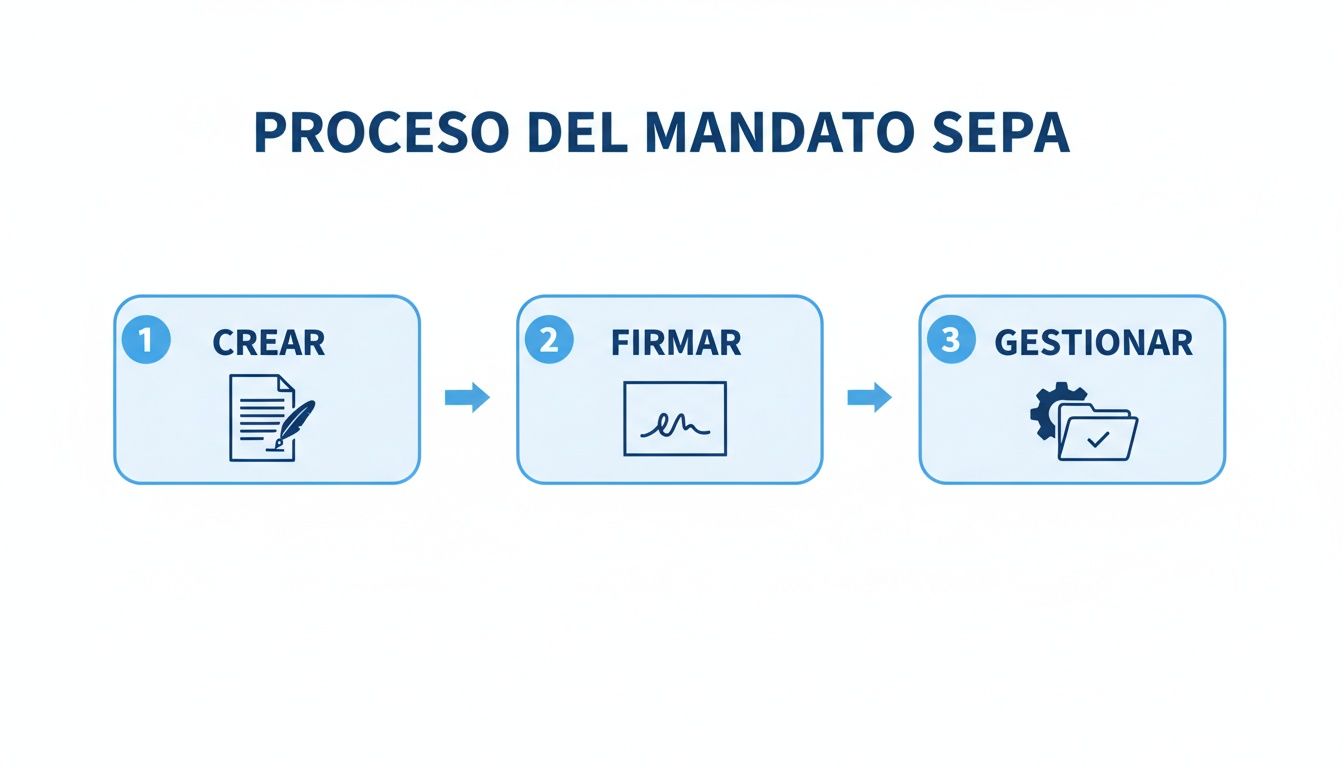
As you can see, it all comes down to creating, signing and managing that customer permission. It is the pillar on which any direct debit rests.
And we are not talking about a minor topic. The volume of these operations is huge and keeps growing. According to European Central Bank data, SEPA direct debits in the euro area reached 11.3 billion operations in the first half of a recent year alone, 2.3% more than the year before. If you are interested, you can see the full ECB statistics here.
The full flow of a batch
Being clear about the full journey will help you see where you can save time and avoid problems. The logical sequence is always the same:
- Gather the data: You put together in your spreadsheet (Excel or CSV) the basic information for each collection: customer IBAN, amount, concept and, very importantly, the reference of the SEPA mandate that authorises you to collect.
- Convert to SEPA XML format: This is where you use a tool like ConversorSEPA. You upload your file and the software validates the data (e.g. that the IBAN is correct) and generates the XML file following the regulation to the letter.
- Upload the file to your online banking: You go to your bank’s batch section and upload the XML file you have just generated.
- Confirmation and follow-up: The bank processes the batch on the collection date you specified. Shortly after, you will see the money in your account and get notifications if any collection is returned.
The key to saving time is not doing the process faster but doing it right first time. Avoiding errors in the XML conversion is the biggest optimisation point for any company.
Tools like ConversorSEPA are designed for exactly that, to remove risk at that critical step. The platform lets you upload your collection list and turns it into valid XML instantly, ensuring your bank will accept it.
By automating the conversion, your admin team can spend time on higher-value tasks, like following up collections, instead of wasting hours creating files by hand—a process that is a constant source of errors. If you also work with bills of exchange, you may want to know how a remittance of effects is managed.
Common mistakes in managing direct debits and how to avoid them
Managing direct debits can be great for your business treasury, but a small slip can turn it into a real headache of returns, fees and wasted time. The key to keeping everything running smoothly is knowing and anticipating the most typical mistakes.
An error that seems trivial, like a mistyped IBAN, is one of the main causes of returned collections. This not only delays your collection but your bank will likely charge you a fee for handling the failed payment. And in the day-to-day of an SME, every euro counts.
To give you an idea of the wider context, public debt in Spain recently reached 101.5% of GDP. In that kind of scenario, optimising every cent of financial management is vital. Avoiding errors in a simple direct debit is one more piece of that puzzle. To dig deeper, you can read more about debt context at the Bank of Spain and you will understand why efficiency is so important.
Manual checks and the “copy and paste” risk
Let’s be honest: human error is almost inevitable when we work by hand with lots of data. Mistyping an IBAN, missing a digit or, worse, mixing up one customer’s with another’s… these mistakes happen every day. Relying only on visual review is like playing the lottery with your collections.
The smartest way to tackle this is to use tools that validate IBANs for you. Software like ConversorSEPA checks the structure and check digit of each account before creating the batch file. It is like having a goalkeeper that stops 90% of these errors before they get onto the pitch.
Think of an IBAN validator not as an extra but as a basic work tool. Every return you avoid is money you save on fees and hours you do not lose on admin. It directly protects your business profitability.
SEPA mandates: the one everyone forgets
Another critical area is managing SEPA mandates. You cannot issue a collection without a valid mandate signed by your customer. The most common pitfalls here are:
- Expired mandate: If you stop collecting from a customer for 36 months, the mandate loses its validity. If you try to collect with it, the bank will reject it immediately.
- Mismatched reference: The Unique Mandate Reference (UMR) must be identical in the file you send to the bank and in the original document. A wrong letter or number is enough to bring the operation down.
- Collecting without permission: Trying to run a collection without having the mandate signed by the customer is not just bad practice; it is illegal and can get you into serious trouble.
The ideal is to have a centralised, up-to-date register of all your mandates. Note the date of the last collection so you do not miss the validity period.
Dates, deadlines and formats that do not forgive
Finally, the calendar and technical format are sacred. If you submit a batch outside the deadlines your bank sets (e.g. with less than 2 business days’ notice for a recurring CORE direct debit), they will reject it. No questions asked.
Likewise, trying to create a SEPA XML file by hand without knowing the strict regulation is a recipe for disaster. The most practical solution is to use software that is always up to date with the latest SEPA scheme version. That way you ensure your files always meet what the bank needs.
Tools to optimise your direct debit management
After reviewing what a direct debit is, the types that exist and the most common mistakes, the million-dollar question is: how can we simplify and secure this whole process? The answer, as almost always, is technology. But not just any technology—tools designed to solve SMEs’ headaches.
A specialised tool is not a luxury. It is a necessity to turn a manual, repetitive, trap-filled task into an agile, secure workflow. Instead of wrestling with XML structure or hoping an IBAN is correct, you can let a system do it for you.
ConversorSEPA: the solution for your batches
This is where tools like ConversorSEPA come in. They were born to be the perfect bridge between your everyday management and the technical requirements the bank demands. Their mission is to remove obstacles exactly where they hurt most.
Look at how their features tackle the problems we have seen:
- Easy, secure conversion: You upload your collection list in a simple Excel or CSV and the tool turns it instantly into a SEPA XML file ready to send to the bank. Even if you come from legacy formats like AEB, it handles everything.
- Automatic IBAN validation: Before creating the batch, the system checks that each IBAN has the correct structure. This cuts the risk of returns from this silly but very common mistake at a stroke.
- Security and regulatory compliance: It gives you peace of mind that files always comply with the latest SEPA regulation. So you can forget about rejections for using an outdated format.
The right technology does not just save you time; it shields your collection process against the costliest errors. It frees your team from repetitive tasks so they can focus on what really matters: analysing and improving your treasury.
For companies that need to go a step further or want full integration, a JSON API lets you fully automate batch creation. What does that mean? That your own management software (ERP or CRM) can “talk” directly to the tool to generate direct debit files without anyone having to intervene manually.
Frequently asked questions about direct debits
Even with the theory clear, day-to-day always throws up specific doubts. Here we answer the most common questions about managing direct debits so you can move with confidence and avoid unpleasant surprises.
One-off or recurring direct debit?
Imagine you have two types of customer: one who buys a product once and another who is subscribed to a monthly service. For each you need a different type of direct debit.
A recurring direct debit (marked as RCUR) is your tool for those regular, stable collections, like gym fees or software subscriptions. All collections are grouped under the same SEPA mandate the customer signed at the start.
By contrast, a one-off direct debit (marked as OOFF) is used for a single collection. It is essential that you choose the correct option in your SEPA XML file. Banks process each type differently, and an error here is almost certain to cause a rejection.
What deadlines do I have to submit a batch?
There is no room for error here: deadlines are sacred and meeting them is crucial for your money to arrive on time.
- SEPA CORE direct debits: For the first collection you make from a new customer, you must send the batch to the bank at least 5 business days in advance. From the second onwards, the deadline relaxes to 2 business days.
- SEPA B2B direct debits: If you work with other businesses, everything is faster. The deadline is only 1 business day in advance.
Missing these deadlines does not just mean a delayed collection. The bank will return the entire batch, affecting all the collections in that file. A small oversight can create a big treasury problem.
What do I do if a customer returns a direct debit?
Do not panic. A return happens, but the key is how you react. First, pick up the phone or send an email to the customer to understand what happened. Often it is a simple oversight or a one-off lack of funds. If so, you can agree to run the collection again on a new date.
However, if the customer says they have cancelled the authorisation, things change. In that case, you must not issue them any direct debit again until they sign a new mandate. Handling returns quickly not only helps you collect sooner but keeps your relationship with your customers healthy.
At ConversorSEPA we help you avoid these and other common errors, turning your Excel or CSV files into valid SEPA XML batches ready for your bank in seconds. Try our tool and speed up your collections from today.